More Information
Expand Your Knowledge
Understanding harm reduction and syringe exchange programs is essential for fostering informed and compassionate perspectives on substance use and its impact on public health. This knowledge equips individuals to actively contribute to creating safer communities, breaking down stigma, and supporting evidence-based strategies that save lives and promote healthier outcomes for all.
What is Harm Reduction?
Compassion, Saving Lives & Providing Second Chances
You can find yourself using harm reduction practices in everyday life, such as wearing a seatbelt or applying sunscreen. You are protecting yourself from harm. In public health, harm reduction strategies are equally important, especially in the context of substance use. Examples include needle exchange programs, which provide clean syringes to prevent the spread of infectious diseases, and naloxone distribution, which equips individuals with tools to reverse opioid overdoses.
01
Meet People Where They Are
Harm reduction accepts that drug use is part of our world and focuses on minimizing harm rather than judging or punishing.
02
Prioritize Dignity
The goal is to improve the health and overall quality of life for individuals and communities, not just to eliminate drug use
03
Provide Client Centered Care
People who use drugs are experts in their own lives and are essential in designing programs that affect them.
Case Studies: Harm Reduction
Centers for Disease Control and Prevention
"Harm reduction is a public health approach that focuses on mitigating the harmful consequences of drug use, including transmission of infectious disease and prevention of overdose, through provision of care that is intended to be free of stigma and centered on the needs of people who use drugs."
Harm Reduction Principles
National Harm Reduction Coalition
“Harm reduction incorporates a spectrum of strategies that includes safer use, managed use, abstinence, meeting people who use drugs “where they’re at,” and addressing conditions of use along with the use itself.”
What Is Harm Reduction?
John Hopkins BSPH
“Harm reduction acknowledges that drugs are widely available in our society. It encompasses the understanding that traditional law enforcement approaches or those that require complete abstinence do not decrease demand, use, or negative health consequences of substance use.”
Syringe Exchanges
Providing Access to Safer Practices
- Research into SSPs have shown that they are:
- Safe and effective
- Cost-saving
- Not increasing illegal drug use or crime
- Reducing spread of hepatitis, HIV, and other infections
- BAHRC is, at it’s core, an SSP that provides safe injection kits
4,739
Safe Kits Distributed
5,625
Narcan Distributed
4,447
Client Encounters
13,669
Safe Sex Kits Distributed
2025 BAHRC Impact Data
Syringe Service Programs
HIV.gov
"Syringe service programs (SSPs) are community-based prevention programs that can provide a range of services, including
- access to and disposal of sterile syringes and injection equipment
- linkage to substance use disorder treatment
- distribution of naloxone, a medication that reverses overdoses
- vaccination, testing, and linkage to treatment for infectious diseases, including HIV and hepatitis B and C
- education about overdose prevention and safer injection practices
- abscess and wound care
- referral to social, mental health, and other medical services"
How do SSPs affect their communities
National Institute on Drug Abuse
“Syringe services programs help protect communities by preventing infectious disease outbreaks and facilitating safe disposal of used syringes. These programs are not associated with increased drug use, crime, or syringe litter in communities.”
SSPs Role in Ending the HIV Epidemic in the U.S.
American Journal of Preventative Medicine
“Syringe services programs have a key role in all 4 Ending the HIV Epidemic initiative strategies-Prevent, Diagnose, Treat, and Respond and thus are instrumental to its success in preventing disease and saving lives.”
Naloxone Use
Overdose Reversal
"Naloxone is a medicine that rapidly reverses an opioid overdose. It is an opioid antagonist." - NIH
What is an overdose?
An Overdose is a medical emergency and occurs when:
"Overdose (OD) happens when a toxic amount of a drug, or combination of drugs overwhelms the body.
People can overdose on lots of things, including alcohol, Tylenol, opioids or a mixture of drugs. Opioid overdoses happen when there are so many opioids or a combination of opioids and other drugs in the body that the victim is not responsive to stimulation and/or breathing is inadequate. " - National Harm Reduction Coalition
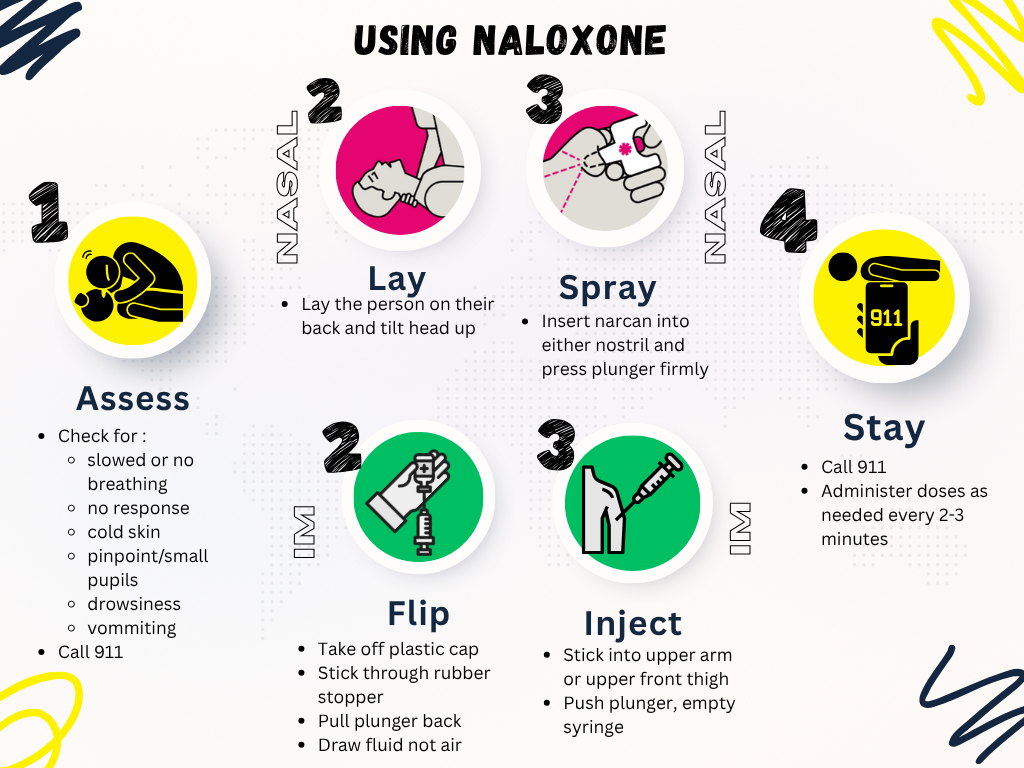
How do I know someone is overdosing?
An individual may show the following signs:
- slowed or no breathing
- slowed or stopped heartbeat
- no response
- cold and clammy skin
- pinpoint/small pupils
- weakness or limp limbs
- pale, blue or purple lips and fingers
- vomiting
- snoring or gurgling sounds coming from the mouth
- drowsiness
If an overdose is suspected or the individual shows symptoms, administer naloxone immediately.
How is it used?
 Button
Naloxone should be used when an individual shows signs or is suspected of an overdose. It comes in two forms, nasal and Intramuscular. Use a form that available.
Nasal Naloxone
Narcan UseThis is a device that is inserted into the nose and administers a dose of Naloxone as a spray.
- Insert the device into the nose
- Press down on the plunger
- Administer another dose (via a new nasal spray) after 2-3 minutes.
Note: You cannot overdose on narcan.
IM Naloxone
IM UseThis form requires the vial and syringe. Inject into the upper arm or thigh.
- Take the wrapper off the syringe and cap off of the vial
- Insert the syringe into the rubber stopper of the vial
- Flip the vial and draw in medication
- Remove the syringe from the vial
- Clear air from syringe (push out air via plunger)
- Insert the needle into the muscle
Is there training available?
END OVERDOSE TrainingYes, we reccommend taking the interactive and informative course by END OVERDOSE.